
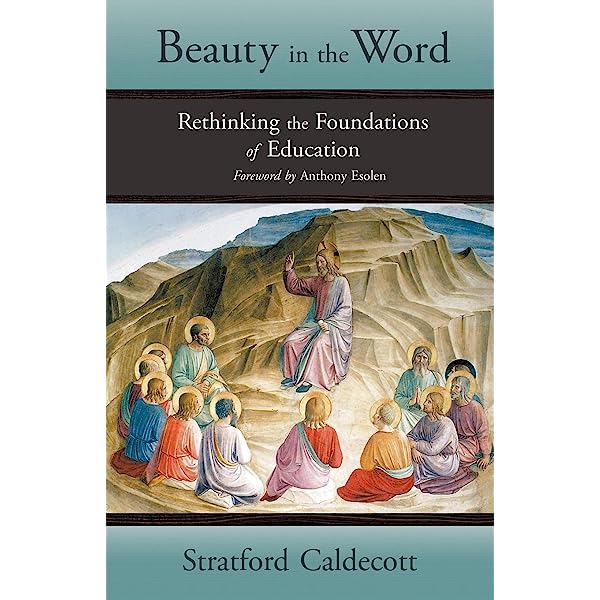
I first discovered the writings of Stratford Caldecott by winning a door prize at a CiRCE conference in 2012. The door prize was a copy of Beauty in the Word. I had been pursuing classical education for almost a decade at this point. I always had a hunch about the great unity between the liberal arts and the Christian Mystery. It was Caldecott who first gave that hunch clarity, vividness, and an invitation to be converted.
You cannot build a community on a truth that has not been incorporated into you, making you the kind of person you are. The person is, to some extent, the message.
Beauty in the Word, p. 86

Stratford Caldecott quickly became one of my distant mentors through his writings. There are so many treasures to discover in Beauty in the Word. The first I’d like to offer for our contemplation is that of attention. “Attention is desire; it is the desire for light, for truth, for understanding, for possession (p. 30).” As we continue reading in preparation for the new school year, consider the ideas in this book that can direct our attention as prayer, the prayer that invites the presence of Christ to transform us and our students.
Some questions to contemplate as a community:
- What is the image of the human person that the liberal arts tradition serves? (the whole work, but especially Chapter I: Child, Person, Teacher: At the Heart of a Catholic School)
- How might a personalist philosophy of education transform the way we see our work as educators? (pp. 31-35)
- How can we serve our students in developing the kind of memory that leads to freedom? (Chapter II)
- How can we serve our students in developing the kind of thinking that leads to freedom? (Chapter III)
- How can we invite our students to be the message through speech that builds community in the Real? (Chapter IV)
- What is wisdom? Since we educate for the purpose of cultivating wisdom and virtue, what is the kind of wisdom that is the end or purpose of everything we do as a school? (Chapter V)
- What does it mean to be learning in love? (Chapter VI)
 kyle E. Albarado
Leave a comment