
Lenten Reflection I presented way back in 2018.
Presented at John Paul the Great Academy
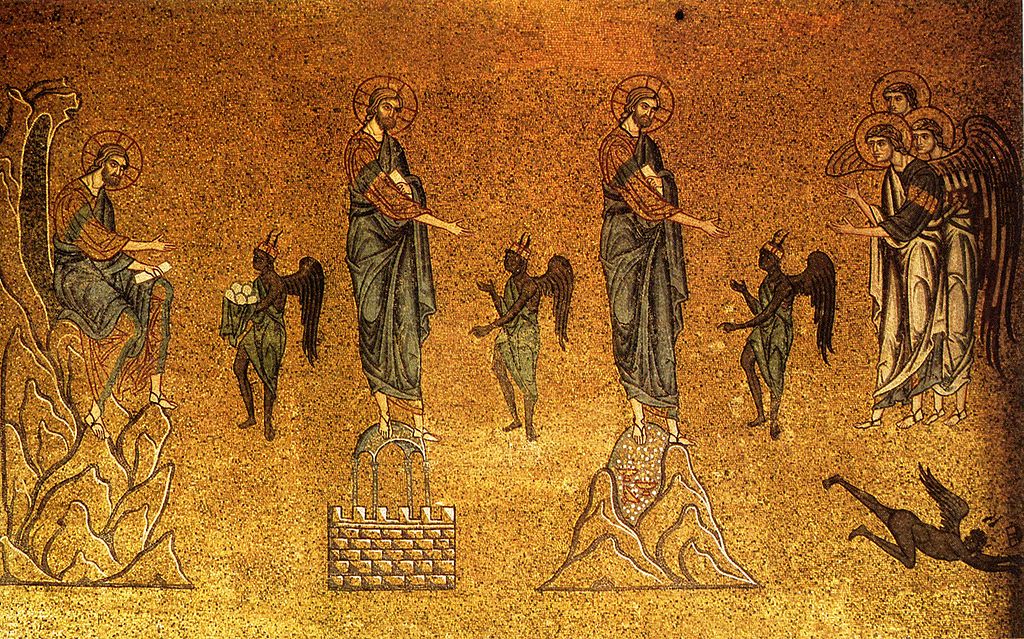
Mt 4: 1-11
Then Jesus was led by the Spirit into the desert to be tempted by the devil. He fasted for forty days and forty nights, and afterwards he was hungry.
The tempter approached and said to him, “If you are the Son of God, command that these stones become loaves of bread.”
He said in reply, “It is written: ‘One does not live by bread alone, but by every word that comes forth from the mouth of God.’”
Then the devil took him to the holy city, and made him stand on the parapet of the temple, and said to him, “If you are the Son of God, throw yourself down. For it is written:
‘He will command his holy angels concerning you’ and ‘with their hands they will support you, lest you dash your foot against a stone.’”
Jesus answered him, “Again it is written, “You shall not put the Lord, your God, to the test.’”
Then the devil took him up to a very high mountain, and showed him all the kingdoms of the world in their magnificence, and he said to them, “All these I shall give to you, if you will prostrate yourself and worship me.”
At this Jesus said to him, “Get away Satan! It is written:
“The Lord, your God, shall you worship
and him alone shall you serve.’”
Then the devil left him and, behold, angels came and ministered to him.
Mt 4: 1-11
The mystery of Lent is that it is a season of joy, gaudium. We begin Lent with Ash Wednesday where we call to mind the reality of our own death. We end Lent with Good Friday where we remember the death of Christ. In between, we exercise our spiritual muscles by voluntarily entering into suffering through prayer, fasting, and almsgiving to better unite ourselves to Christ crucified who voluntarily suffered for us. How is any of this joyful? The mystery is in the paradox, and a paradox is not contradiction, it is contrast. What is the contrast? Lent calls us to contrast pleasure and joy. Pleasure is easy, fleeting, and destructive. Joy is hard, enduring, and transformative. The joy of Lent is the call to imitate Christ.
The invitation to enter into mystery is best encountered through story. The drama of salvation is the best story ever told, but the reality is that the story is still unfolding each day as God pursues us to be a heroic character in this story of redemption. Just as the drama of salvation can be broken down into its prefigurement, being made present by Christ, and made manifest at work in the Church today, Lent too is prefigured by the story of the Exodus, made present in the temptations of Christ in the desert, and made manifest in the liturgical season of Lent. God’s chosen people, Israel, fall into temptation in three specific ways during the Exodus: they are tempted in their faith, hope, and love. Each temptation is answered heroically by Christ in the desert. We are the new Israel through our baptism, a royal nation, a holy people God has chosen to be his own. If we do not enter into the mystery of Lent, we are bound to repeat the same mistakes of the Israelites during their Exodus. An essential principle of classical education, festina lente, make haste slowly, can help us more fully enter into this story, to enter into the mystery of Lent.
Let’s enter the story. The Israelites find themselves in bondage in Egypt. They are oppressed: run down by the demands, distractions, anxieties and busyness of Egypt; so much so they are no longer free to worship God. Like the Israelites, we can easily find ourselves lost and no longer free to worship because we are too attached to and distracted by the things of this world. Through Moses, God frees the people of Israel and leads them into the desert to prepare them for the Promised Land. Rising from the waters of his baptism (like the Israelites rising from the Red Sea), the Spirit leads Christ into the desert to prepare him for his public ministry. Through Christ, the new Moses, God frees us by leading us into the desert of Lent to prepare us for the Kingdom. You would think that the Israelites would have been grateful for their newfound freedom in the desert. They weren’t. It took only three days after witnessing the miracle of the parting of the Red Sea to start grumbling and complaining.
What tempted them to complain? It was fear from a lack of faith. They did not believe that God would provide for them. They looked back on their old life in Egypt, where comfort and pleasure was easy and then resented their current life in the desert. They forgot that pleasure was not enough to really make them happy. How often are we tempted to lose faith because we are afraid to let go of pleasure and comfort? We fear that God will not satisfy our desires and so become addicted to the things of this world because it distracts us from our lack of faith. It is easier to be distracted than to confront our lack of faith. How are we allowing fear and distraction to prevent us from the longing and desire for faith? Are we tempted to complain every time we don’t get what we want, exactly when we want it, and in exactly the way we want it?
We need to be hungry! If you want to train an animal, you let the animal get hungry first. When they are hungry, their senses are sharpened. They are more willing to look and listen for the behavior that will get them the reward they want. If they are full, they will be sluggish, inattentive, and easily led astray (kind of like us when we fill ourselves on pleasure). An example I like to give is the joy of gumbo. While we are waiting for the gumbo to be ready, it is tempting to fill up on french bread and potato salad. By the time the gumbo is ready, we have lost our appetite and desire to eat. This is like the spiritual life. If we fill up on pleasure, we lose the desire for the joy that will truly satisfy. Fasting makes us hungry, not for the things of this world, but for the word of God, for Christ, for the Eucharist, for the food that will satisfy us for eternity.
Christ gave us a heroic example in the desert when he responds to Satan’s suggestion to abuse his power and make bread. Christ has faith in the word of God. It teaches us that just because we can do something doesn’t mean we should. We have the power and ability to seek pleasure. But should we? Instead of abusing the power of our free will, practicing festina lente in fasting, making haste to deny ourselves but doing it slowly, prayerfully, and with purpose, can help us overcome the fear of temptation with faith. If we don’t practice festina lente, we will be sluggish to respond to temptation, increasing anxiety and fear. Or, we will be so quick to act that we will break our fasts for mere pleasure. Imitating the faith of Christ in Lent strengthens our belief.
The second temptation of the Israelites was the temptation to lose hope, to not trust in the word of God. God gives them the ten commandments as rules for holy living. They test God through their rebelling against the commandments, often. Why would anyone break rules from God? It is because we fear that they are not what we need to be happy. We don’t trust the one who gives the rules and so are quick to break them. The Israelites should have known better. We should know better. And yet we rebel just like them. The temptation to lose hope is rooted in a lack of faith that God truly wants the best for us. The ten commandments are not good because they come from God. God knows what is good for us. The ten commandments are good and that is why God gives them to us.
We don’t always understand what we need to be happy and what will hurt us. It can feel like oppression when those in authority hold us accountable to following the rules. I know my daughters feel this way often. When my three year old daughter, Edith, takes off running with great purpose in her goal and I grab and yank her away, it’s not because I want to oppress her. It’s because I know better than her that running to stick a fork in the socket will be devastating for her! Because I love her, I don’t wait for her to understand then obey. Rather, I enforce the rule and invite her to understand through her obedience. Not being quick to act then slow to invite will have tragic results. God loves us more than I love my daughter. How much more trustworthy are his rules? It is fear from a lack of trust that tempts us to rebel.
Christ was tempted to rebel when Satan challenged his confidence that he was the Son of God! When we are tempted to sin, it is a challenge to our confidence in our identity as children of God. Festina lente applied to prayer is how to respond like Christ. We grow in our trust of God by spending time with Him. Our hope is from prayer. Making haste to pray often and slow to pray well is how we imitate Christ in his trust to not put God to the test. It is not confidence in our ability to understand the rules that is the source of hope, it is confidence in the grace God gives us that will provide true hope. Just as faith seeks understanding, hope seeks trust.
The third temptation of the Israelites in the desert was to look for love apart from God, to fall into the worship of idols, it was their worship of the golden calf. This is the most difficult temptation to understand yet the easiest for us to fall into. Why on earth would they worship a statue of their own making after they had seen the power, majesty, and goodness of God? God freed them from Egypt with a mighty display. He gave them bread from heaven to nourish and sustain them. He gave them Moses to lead and guide them. How was that not enough? They were impatient. They looked for love in the ways of the world, to worship like the Egyptians. They would rather worship idols of their own making than to worship the creator of heaven and earth. Better to rule in hell than serve in heaven. Satan fell for this lie, it makes sense that he would use it against others.
It can be a challenge for us to make sense of why the Israelites would be so quick to give their love to things that were clearly not worthy of it. Yet how often do we make idols of the things of this world? How many of us can say we spend more time with the Lord than we do our cell phones and televisions? To treat a thing or person as more worthy of our love than God is to make an idol of it. It is easy to tell ourselves that we really do love God more than anything, but our actions and desires speak louder. The desire to fit in and be like everyone else is powerful! It is easier to believe that we would be better off if our life was different, if we were someone else, somewhere else, doing something else. But like the promises of Satan, this line of thinking has nothing real behind its empty promises. The world cannot fulfill its promise of happiness from pleasure. Pleasure traps us in ourselves. Love of others is what will help us escape from the prisons of our own minds. This is the importance of the practice of almsgiving during Lent. Because we have received great love from God, we seek to give that love to those who are in most need. When we make idols of the things of this world, we fail to love God above all and so destroy our ability to love neighbor as self. In fact, we even destroy our ability to love ourselves since we keep choosing to worship things that hurt us. If we become resentful of our circumstances, we make excuses for our lack of love of neighbor. However, if we truly were better off in another circumstance, God would not have allowed us to be in this one. Faith is the belief that God can provide everything we need. Hope is the trust that God is providing us everything we need. Love is the imitation of Christ to be active in receiving everything we need.
Christ gives us a great witness of festina lente in his response to Satan’s third temptation, the promise that Christ could have everything he wanted if he just worshiped Satan. Christ made haste slowly. Make haste: Christ’s first words are, “Get away, Satan!” Slowly: Christ roots his rejection prayerfully and thoughtfully in his love of the Father, trust in the commandments, and faith in his mission. He is the King of Kings! What on earth makes Satan think that Christ would fall for that nonsense. The falling of the Israelites for the same temptation? Satan’s own weakness to give in to the same lie? Who knows? What we do know is that Christ taught us something important here: Make haste to reject Satan, and be slow to persevere in your love for God.
It can feel overwhelming during Lent to enter into the mystery of joy through prayer, fasting, and almsgiving. After all, the very purpose of penance is to confront us with our weakness. Grace is more powerful than sin or weakness! Our hope is in grace, not our own abilities. In fact, even the knowledge of our sin is a grace and evidence that God is moving within us. With the example, witness, and strength of Christ, let us make haste slowly to follow him throughout Lent. This is a joyful season. Let us close with the following reflection from Pope Benedict XVI:
Once again, it is necessary to make it clear that pleasure is not everything. May Christianity give us joy, just as love gives joy. But love is always also a renunciation of self. The Lord himself has given us the formula of what love is: those who lose themselves find themselves; those who spare or save themselves are lost. It is always an “Exodus”, hence, painful. True joy is something different from pleasure; joy grows and continues to mature in suffering, in communion with the Cross of Christ. It is here alone that the true joy of faith is born.
Lenten Reflection: Festine Lente (Make Haste Slowly)
Lectio Divina
Reflect on the following readings.
Mt 4: 1-11 (found at the beginning of this entry)
From Pope Benedict XVI:
Once again, it is necessary to make it clear that pleasure is not everything. May Christianity give us joy, just as love gives joy. But love is always also a renunciation of self. The Lord himself has given us the formula of what love is: those who lose themselves find themselves; those who spare or save themselves are lost. It is always an “Exodus”, hence, painful. True joy is something different from pleasure; joy grows and continues to mature in suffering, in communion with the Cross of Christ. It is here alone that the true joy of faith is born.
Pope Benedict XVI
Lent in the Economy of Salvation: An Examen
| Prefigurement: Exodus | Made Present: Christ in the Desert | Made Manifest: Liturgical Celebration of Lent |
| Temptation to Fear and Complaining Due to Lack of Faith The Israelites said to them, “If only we had died at the LORD’s hand in the land of Egypt, as we sat by our kettles of meat and ate our fill of bread! But you have led us into this wilderness to make this whole assembly die of famine!”Ex 16:3 | Act of Faith and Right Belief The tempter approached and said to him, “If you are the Son of God, command that these stones become loaves of bread.” He said in reply, “It is written: ‘One does not live by bread alone, but by every word that comes forth from the mouth of God.’” | Make Haste Slowly in Faith through Fasting Do I complain often? What pleasures and attachments do I find hard to let go? How is God calling me to strengthen my faith this Lent through fasting? |
| Temptation to Doubt and Rebel Due to Lack of Hope Moses replied to them, “Why do you quarrel with me? Why do you put the LORD to a test?”Ex 17:2 | Act of Hope through Trust “If you are the Son of God, throw yourself down. For it is written:‘He will command his holy angels concerning you’ and ‘with their hands they will support you, lest you dash your foot against a stone.’”Jesus answered him, “Again it is written, “You shall not put the Lord, your God, to the test.’” | Make Haste Slowly in Hope through Prayer Do I find myself rebelling against God given authority? Do I find it hard to trust? How is God calling me to strengthen my hope this Lent through prayer? |
| Temptation to Idolatry Due to Lack of Love They have quickly turned aside from the way I commanded them, making for themselves a molten calf and bowing down to it, sacrificing to it and crying out, “These are your gods, Israel, who brought you up from the land of Egypt!”Ex 32:8 | Act of Love through Worship At this Jesus said to him, “Get away Satan! It is written:“The Lord, your God, shall you worshipand him alone shall you serve.’” | Make Haste Slowly in Love through Almsgiving How am I making idols in my life? Do I find it hard to love others? How is God calling me to strengthen my love this Lent through almsgiving? |
 kyle E. Albarado
Leave a comment